Commitment to supporting and upholding PLC’s Christian ethos, values and inclusive culture
As Principal of THINK Global School, I lead a multifaith residential community built around our eight school values. Our students and staff bring different beliefs, cultures and experiences, and those values guide how we live and learn together. I would support PLC’s Christian ethos through the way I lead, the relationships I build and the decisions I make. I am drawn to the College’s commitment to scholarship, character and service, particularly its ambition for girls to use what they learn to contribute to their communities.
As a travelling school, we learn in countries where faith shapes community life in different ways. In Mumbai, students encountered a city shaped by many religious traditions. In Kota Kinabalu, our module on pluralism gave them a chance to explore how people of different faiths and cultural backgrounds live together. As Principal, I help students approach these experiences with curiosity and respect, listen to people describe their beliefs in their own words and reflect on what they learn. Within our own community, I use restorative conversations when relationships are strained, helping people hear one another, understand the impact of their actions and agree on what they can do to repair the relationship.
At Tay Creggan, I saw how deliberately a school can help girls feel they belong. Through our Envision program, incoming Year 9 girls had time to get to know the campus and begin building relationships with staff and peers. As the designated Child Safety Officer, I was also responsible for staff training, reporting processes and responding to concerns. Both experiences shaped my understanding of care. It’s there in the way we welcome a student and in whether she knows who to turn to when she needs help.
At PLC, I would take time to understand how the College expresses its Christian purpose through its traditions, relationships and service. I would take part in the life of the College and listen to girls, staff and families about how they experience that purpose. My experience leading a multifaith community would help me welcome people of different beliefs while actively supporting the Christian identity that gives PLC its distinctive character.
I would bring that commitment into the work as Head of the Centre for Innovation & Research. In choosing what to investigate, I would ask whose experience we still need to understand and how the work could serve others. I would give girls a voice in shaping those questions, treat teachers as partners in inquiry and communicate findings honestly, including when they challenge our assumptions. I would also look for opportunities for girls to put their learning to work in service of others, within the College and in the wider community. That is one way I could help connect PLC’s commitment to scholarship with its commitment to care and service.
Demonstrated expertise in educational research and its translation into developmentally appropriate teaching, learning and wellbeing practice from ELC to Year 12
Some of the questions I care most about as a school leader began in my own classroom. What makes a student willing to stay with a difficult task? How do we give young people meaningful choices while teaching them the knowledge and skills they need to make those choices well? My first Master of Education, at the University of Melbourne, drew on flow theory to examine the conditions that help students become deeply absorbed in learning. My second master’s degree, at Deakin University, examined the experiences of graduate teachers on fixed-term contracts in Victorian secondary schools and the implications for staff retention. That research sharpened my ability to interpret policy, weigh different forms of evidence and consider how schools can support early-career teachers through mentoring and timely feedback.
Developing the THINK Potential Framework
As Principal of THINK Global School, I have worked with our executive leadership team to review our program and introduce the THINK Potential Framework. Our students learn across several countries each year, so we needed a shared understanding of effective teaching, learning and wellbeing practice across changing settings. I began by interviewing students, parents and staff. Their perspectives helped shape the framework’s three pillars and connect the research to the daily experience of our community.
- Wholebeing draws on systems-informed positive psychology (Kern et al., 2020) and guidance on measuring wellbeing (Michaelson et al., 2012). This encourages us to consider how relationships, routines and school structures influence wellbeing. In practice, weekly one-to-one advisory conversations, community circles and restorative responses to conflict give students regular opportunities to raise concerns, reflect on relationships and participate in repairing harm.
- Personal Pathways draws on Csikszentmihalyi’s flow theory, particularly the balance between challenge and skill. Our THINK cycle, informed by the design cycle, provides a structure for inquiry, feedback and revision. The competency-based Future 9 Framework gives students and staff a shared language for discussing evidence of growth and identifying next steps.
- Global Immersion draws on experiential and place-based learning. In each country, students investigate a question grounded in that place, learn from local partners and apply what they discover. In Melbourne, partnerships with South East Water and the Yarra Riverkeeper Association connect field experiences with students’ regenerative designs for waterways.
The consultation process has helped build a shared understanding of the framework and stronger ownership among students, parents and staff. Student voice informed its development, while the Future 9 competencies provide a language students can use to recognise and explain the skills they are developing.
Translating research into teaching and professional practice
Digital learning and AI. Over the past eighteen months, I have overseen the development of THINK Global School’s AI Teaching and Learning Policy through consultation with staff and students. Drawing on research from AI and Education from MIT and Human Flourishing at Harvard, our central question has been what students can explain and do independently after using AI, and how its use affects their development as learners. Our policy distinguishes tasks that permit full use of AI, tasks where AI may assist and fully human tasks. This gives educators a common basis for explaining assessment expectations and discussing appropriate use with students. For younger learners, I would work with colleagues to consider how the learning purpose, adult guidance, privacy and developmental stage should shape decisions about AI.
Working across ELC to Year 12 at PLC
My direct leadership experience is strongest in secondary education. At PLC, I would bring my experience in inquiry design, pastoral care and transitions to work alongside educators with expertise in each developmental stage. For transitions such as ELC to Prep and Year 6 to Year 7, I would draw on the Early Years Learning Framework and the Junior School’s existing approaches, working with colleagues to identify what children need to feel secure, build relationships and engage confidently in a new setting.
One practical starting point would be a cross-school inquiry into how students act on feedback. ELC educators might observe what a child tries after receiving guidance during play. Junior School students could show what they changed and explain their next step. Senior School girls could compare drafts and discuss which feedback helped them make a better decision. The shared question would allow colleagues to learn from one another while examining evidence appropriate to each stage. I would involve learners in age-appropriate ways, bring educators together to evaluate what changed and return to students to explain how their contributions informed our practice.
Proven capacity to establish and evaluate research and innovation initiatives, including purposeful digital learning and AI, with measurable educational impact
At THINK Global School, one of my priorities as Principal is making learning and progress clearer in a school where the curriculum moves with us. Working with our academic team, I have helped clarify the relationship between learning targets, task-specific rubrics, evidence and reporting. In our Melbourne program, for example, students draw on fieldwork and disciplinary learning to develop a proposal for a regenerative design. The poster and pitch give teachers concrete evidence to assess, including how students use research, explain their reasoning and consider whether their proposal could work.
Digital learning has also mattered when students have been unable to join us onsite. We moved to remote provision with clear learning expectations, educator contact and opportunities for students to meet online. My role included communicating with students and families and maintaining a personal connection through portfolio conversations. That experience informs the questions I would ask about any digital initiative at PLC. Can students participate? Do they understand what to do next? Can teachers see and respond to their progress?
At Future Anything, I led a year-long strategic planning project with NOVO Education, drawing on student outcomes, staff feedback and community engagement in reviews that informed adjustments to the plan. I also led a six-month change project with Manea Senior College, working with its executive team to turn strategic priorities into actions. Earlier, at Future Schools, I helped move professional learning online. Membership grew by 50 per cent over the following eighteen months, providing a measure of increased reach. Evidence of changes in teaching or student learning would require a separate evaluation.
At PLC, an example could be a proposed trial of AI-supported feedback with a cohort of students. This would begin by establishing how girls currently use feedback and by agreeing with teachers on what improvement would look like. We could compare drafts against common criteria, ask students which feedback influenced their decisions, and examine changes in teacher workload and student independence. I would build in privacy protections, academic integrity expectations and teacher oversight from the outset. The findings would give PLC a basis for deciding whether the approach merits further use and what it could contribute to the College’s understanding of girls’ learning.
Strong capacity to lead coaching, professional inquiry and staff development, building teacher and leadership capability through reflection, feedback and collaboration
One of the parts of being a Principal I most enjoy is sitting down with a colleague and giving them time to think about their work. At THINK Global School, I use professional reviews to ask what is rewarding, where a colleague is getting stuck and what they would like to be able to do better. We then agree on something specific to work towards and what support will make it achievable.
In one conversation, an educator spoke about the difficulty of finding their way through a school whose curriculum, advisory and operational systems sit across several platforms. They had begun building a personal map of those systems. We agreed to make that work a professional growth goal and develop it into a resource future staff could use during onboarding. I valued that the goal came from a problem the educator understood firsthand and gave them a way to improve the experience for others.
As a qualified GROWTH coach, I use goal-focused coaching to support professional learning. In Term 1, I meet individually with each staff member to set a goal grounded in their practice. In Term 2, we translate these conversations into a THINK Action Plan covering contribution to the community, personal growth and professional learning. I have observed staff taking greater initiative in acting on their goals. We begin our weekly staff meetings by sharing “small wins”, giving colleagues opportunities to recognise progress and learn from one another’s practice.
I have also used this coaching approach with teams. At Tay Creggan, work on the Envision framework gave staff a shared reason to examine how they planned inquiry and what girls were learning through it. At Future Anything, I designed and facilitated professional learning on inquiry, project-based learning and entrepreneurial thinking, adapting it to the priorities of teachers, curriculum leaders and executive teams. At Preshil, I established a graduate teacher mentoring initiative involving regular meetings, observation, feedback and discussion of student progress. Feedback from teachers and students pointed to greater teacher confidence and stronger student engagement.
At PLC, I would work with teams and individuals to use coaching tools to help at different career stages. A graduate teacher might benefit from observing an experienced colleague and receiving feedback on one aspect of a lesson. An established team might want to compare student work and investigate why some girls are progressing more readily than others. An aspiring leader might need practice facilitating those discussions. I would build time for this work into the Centre’s plans and return to it with colleagues so we could see what had changed in practice.
Demonstrated ability to establish the Centre’s structures, programs and resource priorities, with effective budget management and ethical approaches to research and technology
What appeals to me about founding the Centre is the opportunity to build something with people who already know PLC well. I would begin by listening to the Principal, Executive, teachers and girls, then work with colleagues to agree on a small number of questions the Centre could investigate well. An early responsibility would be to establish how those questions are selected, who leads each project, what support is available and how findings reach the people who can act on them.
As Principal of THINK Global School, I bring experience coordinating curriculum, staffing, wellbeing and residential operations across different countries. In planning for the Melbourne term, for example, I worked to clarify where responsibility sat for curriculum design, logistics and final risk decisions. That clarity matters when several teams contribute to the same program and decisions have implications for both learning and student safety. At Tay Creggan, I oversaw campus operations, educational programs and staff development within Strathcona’s wider priorities. At Future Anything, I managed program delivery and stakeholder relationships and this commercial experience gave me a practical appreciation of what it costs to deliver a program well and what it takes to sustain it.
For the Centre, I would work with the Finance team to build a costed program that accounts for teacher release, specialist advice, partnership commitments, technology and evaluation. I would review spending and progress at agreed milestones, with clear reporting to the Executive and Council. A central judgement would be how much the College can take on while giving teachers the time to do the work properly.
My experience in different leadership roles also informs how I would establish the Centre’s research practices. Students and families should understand what participation involves, how information will be used and who can see it. I would build in appropriate consent and assent, confidentiality and ethics review, and work with the College’s digital and ICT leaders to assess privacy, accessibility and human oversight before technology trials begin. These are practical responsibilities that would sit alongside the Centre’s academic work from its first project.
Exceptional capacity to build university and professional partnerships, engage students in inquiry and communicate research and practice within and beyond PLC
A strength of my work is bringing people together around a question they care about and helping them see what they could achieve together. Across THINK Global School, Future Anything and Future Schools, I have built relationships that connect students and educators with expertise beyond their own communities. I invest time in understanding what each partner wants to achieve and establishing a shared purpose that guides our work.
At Future Schools, I worked with our team during the COVID lockdowns to develop an online professional learning platform that helped grow membership to more than 100 schools within six months. Interviews with Valerie Hannon, Pasi Sahlberg and Yong Zhao, alongside virtual school visits, connected educators with ideas and colleagues at a time when many were working in isolation. I also developed the Future Leaders program, supporting participants to present their thinking and receive individual coaching. Participant feedback highlighted the value of this support, including an Assistant Principal from Berry Street who reported becoming a clearer and more engaging speaker, and a Director of Student Learning at Cornish College who described the program as among the best professional learning he had undertaken.
I have developed relationships with staff in New Metrics at the University of Melbourne and with my research supervisors at Deakin University that I would seek to build into purposeful collaborations at PLC. My Deakin research into graduate teacher retention provides a starting point for practitioner inquiry into mentoring and professional growth. I would approach my supervisors about research advice or introductions and work with my New Metrics contacts to identify expertise relevant to the Centre’s priorities. Each collaboration would begin with a question that matters to PLC’s teachers and girls, with clear responsibilities, ethical arrangements and agreement about how findings would be shared.
Student inquiry is central to my approach. As Principal of THINK Global School, I support an educational model in which students pursue independent questions through Mastery, service learning and personal projects. My earlier teaching of IB Visual Arts and Theory of Knowledge, and supervision of Extended Essays, involved guiding students to frame questions, examine evidence and communicate their findings. At PLC, I would build on this experience by involving girls in shaping research questions and discussing what findings mean. Younger children could contribute through conversation, observation and creative expression, while older girls could help design inquiries, gather evidence and present findings. I would also ensure they could see how their contributions influenced the Centre’s work.
I have communicated educational practice through keynotes at The Age Education Conference, the Innovation in Education Festival, Reimagined Melbourne, ASAB WA and Lutheran Education. Alongside this work, I have built an international LinkedIn community of more than 10,000 followers, where I share ideas, participate in professional conversations and connect with educators and researchers. At PLC, I would draw on these relationships to identify collaborators and create opportunities for colleagues to share their research and practice internationally.
I would support colleagues to communicate through seminars, practice guides, publications and professional exchanges, helping the Centre produce knowledge that teachers can use and girls can recognise in their own experiences. My ambition would be to help establish the Centre as an internationally respected contributor to girls’ education, known for research developed with girls and teachers and for sharing clearly what that research means for practice.
Find relevant evidence
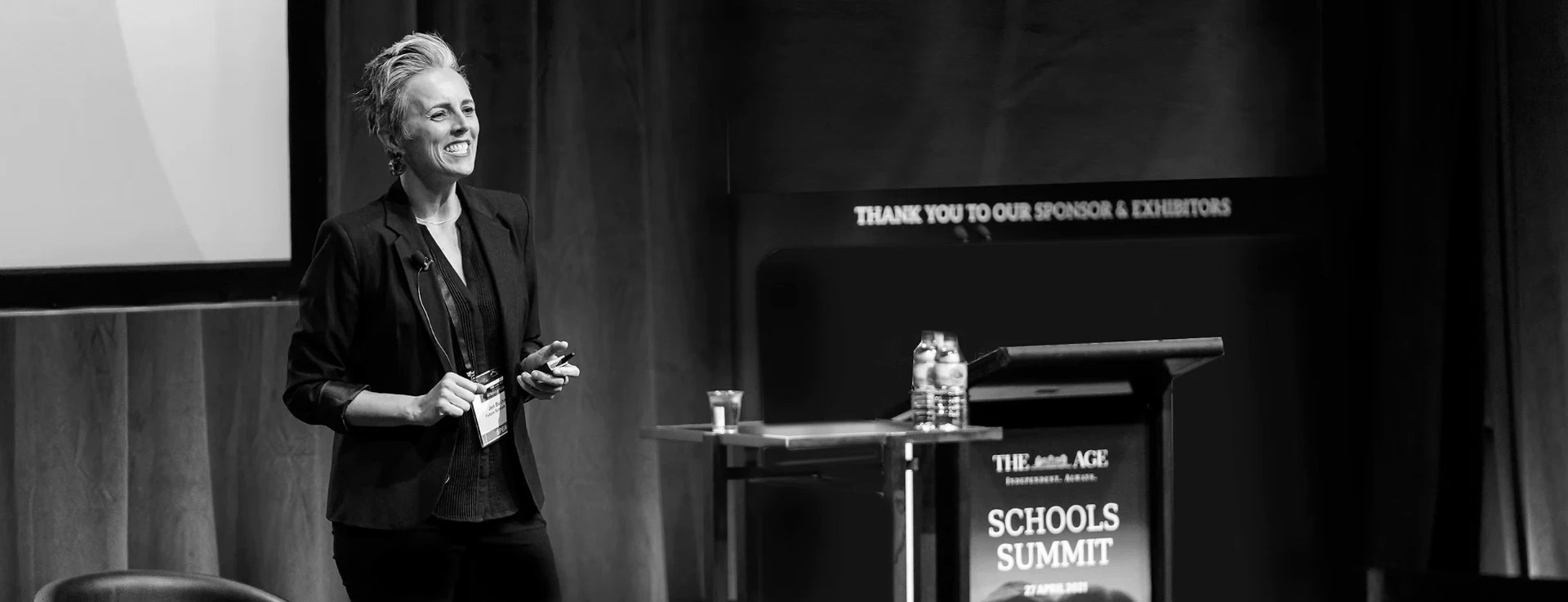
Speaking at The Age Schools Summit, Melbourne.